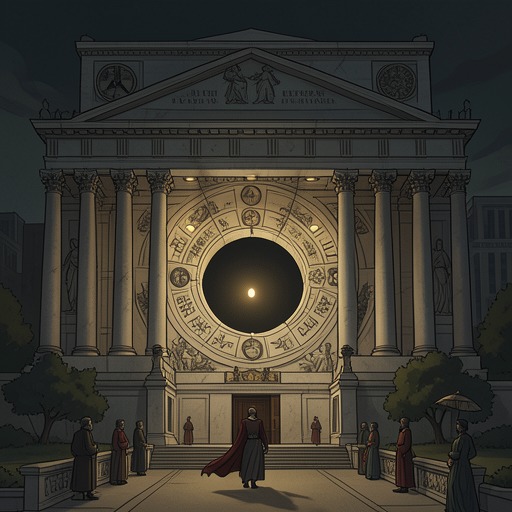
As above, so below
The Lost SymbolAs above, so below is a Hermetic adage expressing a correspondence between the physical world and the heavenly or spiritual realm. In the novel, it matters as more than an old saying: it shapes how Robert Langdon reads a concealed message, illuminates the meaning of a transformed Masonic symbol, and echoes in Mal’akh’s account of the powers he hopes to command. Across those uses, correspondence becomes a way to connect what appears above with what has been hidden below.
Meaning and First Appearance
The phrase enters the immediate crisis as a deliberately unsettling reply. A caller tells Robert Langdon that Peter Solomon is in purgatory; when Langdon challenges the claim, the man answers with the adage rather than an explanation. Langdon recognizes it as an ancient Hermetic saying expressing a belief in a physical connection between heaven and earth. Its familiar words therefore sharpen the threat: the caller is treating Peter’s condition, and the ancient portal Langdon has been ordered to unlock, as parts of a larger system joining different levels of existence.
That exchange also gives the phrase a practical role in the unfolding mystery. The caller says Peter identified Langdon as the only person who could unlock the portal, and instructs him to find it, adding that Peter will point the way. The allusion to correspondence between above and below becomes pointed when Langdon later studies Peter’s severed hand, whose symbols initially seem to direct attention upward. Rather than treating that apparent orientation as fixed, Langdon turns the wooden base over, making the fingers point down. From this altered viewpoint, XIII reads as a Roman numeral and the remaining characters as Roman letters, forming SBB. The clue leads the investigation toward SBB XIII. The saying has thus moved from ominous verbal riddle to a method of looking: the same signs yield their meaning when their orientation changes.
Symbolic Correspondence and the Rose Cross
The principle returns when a stone cube opens after Langdon rotates a Masonic ring through thirty-three degrees. The cube’s hinged panels fall outward, leaving a cross-shaped form. Its transformation first invites a Christian interpretation, but Langdon rejects that as too narrow for Freemasonry, which includes members of many religions and people who name no God. He instead explains the cross as an older sign of the intersection of human and celestial dimensions, where humanity and divinity meet. In this account, the adage describes a relation made visible in the symbol: earthly and heavenly are distinct, yet joined.
The circumpunct at the cross’s center supplies another layer. Langdon has already encountered it as a symbol with multiple meanings; here he identifies one esoteric meaning as the rose, associated with alchemical perfection. Placed at the center of the cross, it creates the Rose Cross, a symbol common in Freemasonry. The Scottish Rite includes a degree called Knights of the Rose Cross, honoring the early Rosicrucians and their influence on Masonic mystical philosophy. The cube’s physical change therefore converts a simple solid into a compact symbolic argument: the cross marks the meeting of dimensions, and the rose at its center adds the idea of perfection. The adage helps Langdon read the relation among the parts rather than mistake the image for an exclusively Christian emblem.
Mal’akh’s Spiritual Reading
The same words recur in a very different register while Mal’akh drags the unconscious Langdon from his house. A television preacher leads a congregation in the Lord’s Prayer; when they recite the line about earth and heaven, Mal’akh silently answers with the Hermetic adage. His response places the prayer inside his own interpretive system. He argues to himself that religious language preserves traces of older traditions, associating Amen and related forms with the Egyptian god Amon, whom he regards as a prototype for later faces of God. This is Mal’akh’s belief, presented through his thoughts, not a neutral account of religious history.
For Mal’akh, correspondence between visible and invisible realms is also bound to the Art, his practice of ritual magic. He believes a practitioner can open a portal to the spiritual realm and summon forces that act in the earthly world. He divides those forces into Light, which heals, protects, and creates order, and Dark, which destroys and brings chaos. In his scheme, their help requires offerings: prayers and praise for the forces of Light, blood for those of Dark. The greater the sacrifice, he believes, the greater the power transferred. He recalls beginning with animals and becoming more daring in his offerings, framing the night’s intended act as the final step in that progression. The adage consequently joins two levels of Mal’akh’s scheme: spiritual forces above, and earthly action through which he hopes to call them down.
Narrative Function
The novel gives the adage several connected but not identical functions. It is a threat when used to answer Langdon’s question about Peter, a clue when Langdon reverses the hand’s orientation, and an interpretive key when the opened cube becomes the Rose Cross. Its recurrence invites the reader to reconsider apparent divisions—up and down, physical and spiritual, human and celestial—without treating every use as proof of a single doctrine. Langdon applies the saying to interpret visible signs; Mal’akh uses it to justify a supernatural ambition and its escalating violence.
That contrast is essential to the phrase’s significance. For Langdon, correspondence is a disciplined way to test how symbols change meaning with their angle and context. For Mal’akh, it is part of a system in which invisible forces can be enlisted through ritual and sacrifice. The same words therefore connect the novel’s puzzles to its conflict over knowledge and power: understanding a relationship between realms does not establish that every claim made in its name is true, or that every attempt to cross that boundary is justified.